
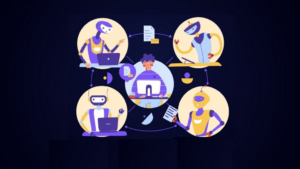
As we reach mid-year, a clear pattern has emerged from successful AI implementations: single-purpose AI models and isolated chatbots are hitting their limits in solving interconnected enterprise problems. The next evolution in AI architecture—multi-agent systems—is becoming essential for tackling complex challenges that span data silos, require multiple specialties, and demand coordinated execution. These systems don’t just answer questions; they decompose complex problems, assign specialized roles, collaborate, and execute workflows with a level of sophistication that mirrors how effective human teams operate.
This mid-year deep dive explores the orchestration layer that turns individual AI capabilities into cohesive, enterprise-grade solutions. By architecting teams of specialized agents that communicate, debate, and collaborate, organizations can solve problems that were previously too fragmented, dynamic, or nuanced for any single AI model to handle—from dynamic supply chain optimization to holistic customer experience management.
The Orchestration Imperative: Why Multi-Agent Systems Solve What Single Models Cannot
Enterprise challenges are rarely isolated. Consider optimizing a global supply chain: it requires analyzing real-time logistics data, monitoring geopolitical risks, adjusting production schedules, and negotiating with suppliers—all simultaneously. A single AI model, no matter how large, struggles with this multi-faceted, dynamic coordination.
Multi-agent systems excel here through emergent collaboration. Each agent specializes in one domain (logistics forecasting, risk analysis, negotiation protocols) but operates within a structured communication framework managed by an orchestrator. This approach offers three transformative advantages:
- Specialization Over Generalization: Instead of forcing one model to be mediocre at everything, you combine multiple models, each fine-tuned to excel in a specific task (data analysis, creative generation, code execution, API integration).
- Parallel Problem-Solving: Agents can work simultaneously on different sub-tasks, dramatically accelerating workflows that would be sequential if handled by a single AI or human team.
- Resilience Through Redundancy: The system can route around failures. If one agent’s approach fails, the orchestrator can assign the task to another agent with a different methodology or expertise.
The Anatomy of an Enterprise Multi-Agent System
Building an effective system requires understanding four core components that work in concert:
- Specialized Agent Roles
Each agent has a defined personality, capabilities, and tools. Common roles in enterprise systems include:
- Researcher Agent: Specializes in gathering and synthesizing information from databases, APIs, and documents.
- Analyst Agent: Expert in data analysis, pattern recognition, and generating insights from structured data.
- Critic/Reviewer Agent: Tasked with validating outputs, checking for consistency, bias, or errors.
- Executor Agent: Handles API calls, database updates, and interactions with external systems.
- Coordinator/Orchestrator Agent: The “project manager” that breaks down tasks, assigns them, and manages the workflow.
- The Communication Fabric
Agents need structured ways to exchange information. This goes beyond simple message passing to include:
- Shared Context Memory: A common workspace (often a vector database) where agents can store and retrieve intermediate results, contextual information, and historical decisions.
- Standardized Protocols: Well-defined communication patterns (publish/subscribe, request/response) that ensure agents understand each other regardless of their underlying model architecture.
- Debate and Consensus Mechanisms: Sophisticated systems allow agents to propose different solutions, debate their merits, and arrive at consensus through structured reasoning, much like a panel of experts.
- The Orchestration Engine
This is the intelligence core that manages the overall process:
- Task Decomposition: Breaking a high-level goal (“Reduce supply chain costs by 15% while maintaining service levels”) into specific, actionable sub-tasks.
- Dynamic Scheduling: Assigning tasks to available agents based on their specialization, current workload, and past performance.
- Conflict Resolution: Managing disagreements between agents and ensuring the workflow progresses toward the objective.
- Quality Control: Implementing validation checkpoints and review steps throughout the process.
- The Enterprise Integration Layer
The system must connect securely with existing business infrastructure:
- API Gateways: Secure connections to internal systems (ERP, CRM, databases) and external services.
- Authentication & Authorization: Role-based access control ensuring agents only interact with systems they’re permitted to use.
- Audit Logging: Comprehensive tracking of every agent decision, action, and data access for compliance and debugging.
The Open-Source Orchestration Stack
Several frameworks have matured to make building these systems practical:
- CrewAI: A high-level framework that explicitly models roles, tasks, and processes. It allows you to define agents with specific roles, goals, and tools, then chain them together into sophisticated workflows with built-in delegation and collaboration mechanisms.
- LangGraph: Built on LangChain, this framework uses graph-based architecture to define complex, stateful workflows where agents are nodes and the edges control the flow of execution. It’s particularly powerful for building cyclic, recursive, or self-correcting agent systems.
- AutoGen: Developed by Microsoft, this framework specializes in creating conversable agents that can solve tasks through structured dialogue and negotiation, ideal for scenarios requiring debate and consensus.
- Haystack with Agents: Using Haystack’s pipeline architecture with agent nodes enables the creation of sophisticated question-answering and workflow systems that can integrate retrieval, generation, and decision-making components.
Implementing Enterprise Multi-Agent Systems: A Mid-Year Roadmap
For organizations considering implementation in the second half of the year, this phased approach balances ambition with practical execution:
Phase 1: Problem Selection & Design (Months 1-2)
- Identify a Contained but Valuable Problem: Choose a challenge that is complex enough to require multiple specialties but bounded enough to be manageable. Examples: automated competitive intelligence gathering, dynamic financial report generation, or customer onboarding optimization.
- Design the Agent Team: Define the specific roles needed. For competitive intelligence: a Researcher (gathers data), an Analyst (identifies trends), a Visualizer (creates charts), and a Writer (drafts reports).
- Map the Communication Flow: Diagram how information will pass between agents and what decisions each agent must make.
Phase 2: Development & Integration (Months 3-4)
- Build Individual Agents: Develop and test each agent type independently using your chosen framework. Focus on making each agent robust in its specialized task.
- Establish the Orchestration Logic: Implement the coordinator agent’s decision-making logic for task assignment and workflow management.
- Integrate with Enterprise Systems: Connect the agents to necessary data sources and APIs with appropriate security controls.
- Implement Human-in-the-Loop Checkpoints: Design clear intervention points where humans review critical decisions or outputs before they proceed.
Phase 3: Testing & Refinement (Months 5-6)
- Run Controlled Pilots: Deploy the system with a limited scope and user group. Monitor not just outcomes but the collaboration process between agents.
- Establish Evaluation Metrics: Define success beyond task completion—measure efficiency gains, quality improvements, and reduction in human effort.
- Refine Based on Feedback: Adjust agent behaviors, communication patterns, and orchestration logic based on real-world performance.
Complex Enterprise Applications: Where Multi-Agent Systems Shine
- Regulatory Compliance Monitoring: A system where one agent monitors regulatory updates, another maps them to internal policies, a third identifies gaps in compliance, and a fourth generates implementation plans and required documentation changes.
- Dynamic Customer Support Escalation: Instead of linear support ticket routing, a multi-agent system can simultaneously analyze customer sentiment, retrieve relevant documentation, check service history, and determine optimal resolution paths—escalating to human agents only when truly necessary.
- Strategic Planning Simulation: Agents representing different business units (marketing, production, finance) can simulate various strategic scenarios, negotiate resource allocation, and predict outcomes based on their specialized knowledge and access to relevant data.
Conclusion: From AI Tools to AI Organizations
The evolution from single AI models to multi-agent systems represents a fundamental shift in how enterprises leverage artificial intelligence. We’re moving from using AI as a tool to building AI organizations—teams of specialized digital entities that collaborate to solve problems too complex for any individual agent or human team member.
As we progress through the year, the organizations that will gain the most significant competitive advantage are those that master the orchestration layer—the “management” of AI teams. By building these collaborative systems, you’re not just automating tasks; you’re creating an entirely new capability for tackling enterprise challenges that were previously considered too dynamic, interconnected, or nuanced for automation.
The tools and frameworks are now mature enough for serious enterprise implementation. The mid-year point is the perfect time to move from exploration to building your first multi-agent teams that can tackle the complex challenges standing between your organization and its strategic objectives.
Ready to architect collaborative AI teams for your enterprise challenges? Clear Data Science specializes in designing and implementing sophisticated multi-agent systems using open-source frameworks to solve complex business problems. Contact our orchestration experts to design your multi-agent solution.
Keywords: Multi-Agent Systems, AI Orchestration, Enterprise AI, CrewAI, LangGraph, Autonomous Agents, AI Collaboration, Complex Problem Solving, Agentic Workflows, Open Source AI, Clear Data Science.