
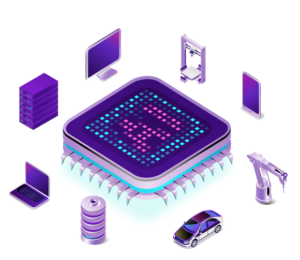
The Internet of Things (IoT) has long promised a world of connected intelligence, but a fundamental limitation has persisted: most “smart” devices are merely data collectors, relying on distant cloud servers for processing and decision-making. This creates unacceptable latency, bandwidth costs, and single points of failure. Today, a revolution is underway. Fueled by the hardware trends of ultra-efficient processors and the software innovation of small, robust AI models, we are entering the era of edge-native intelligent agents—autonomous AI that lives, reasons, and acts directly on IoT devices themselves.
This shift transcends simple “edge inference.” We are moving from devices that detect to agents that decide and do. An IoT sensor no longer just streams temperature data; an onboard agent analyzes trends, predicts a failure, and orchestrates a local response by communicating with other machines—all in milliseconds, all without a cloud round-trip. This is the true potential of real-time innovation: embedding proactive intelligence into the very fabric of our physical operations.
Why the Edge Agent Revolution is Happening Now
Three converging forces are making this possible:
- The Hardware Efficiency Leap: Following CES 2026 trends, new microcontrollers (MCUs) and system-on-chips (SoCs) like the RA8 from Renesas or next-gen ARM Ethos-U NPUs pack dedicated AI acceleration into power-sipping packages. They can run billion-parameter models at milliwatt power levels, finally providing the computational muscle for on-device reasoning.
- The Rise of Ultra-Small, Specialized Models: The open-source ecosystem is producing models perfectly engineered for the edge. Think not of 70B parameter giants, but of sub-1B parameter models like Google’s Nano 2, Meta’s Llama 3.1 8B (heavily quantized), or specialized models from Ologn AI fine-tuned for sensor data. These are small enough to flash onto a device’s memory yet capable of complex classification, forecasting, and decision-making.
- The Maturation of Agentic Frameworks for Constrained Environments: Lightweight, Rust- or C++-based inference runtimes (like TensorFlow Lite Micro and Apache TVM) are being integrated with minimalist agent orchestration logic. This allows developers to build deterministic “if-this-then-that” rules alongside probabilistic AI reasoning, creating robust hybrid agents for unpredictable real-world environments.
Architecting the Edge-Native Intelligent Agent
Deploying an agent to a resource-constrained device requires a fundamentally different architecture than cloud-centric design.
Core Components of an Edge AI Agent:
- Local Sensory Perception: Direct integration with the device’s sensors (cameras, accelerometers, thermistors) for real-time data ingestion.
- On-Device Reasoning Engine: A quantized SLM or a tiny transformer model that processes sensor data, contextualizes it with historical data stored in local memory, and executes a pre-defined decision tree or generates a plan.
- Lightweight Action Orchestrator: Micro-code that translates the agent’s decision into immediate actions—actuating a motor, adjusting a valve, flashing a warning LED, or sending a concise alert packet to a neighboring device via local mesh network (like Bluetooth LE or Thread).
- Selective Cloud Sync: The agent operates autonomously 99% of the time. It only initiates communication with the cloud to report aggregated insights, request a model update, or escalate a truly anomalous event beyond its operational parameters.
The Open-Source Stack for Edge Agent Development
Innovation here is driven by accessible, modular tools:
- Model Training & Compression: Start with a small base model (e.g., Phi-3-mini) and fine-tune it on your specific sensor data using PyTorch or JAX. Then, aggressively quantize it using GPTQ or convert it to an edge-optimized format like ONNX or a TensorFlow Lite FlatBuffer.
- Runtime & Orchestration: Deploy the model using TensorFlow Lite Micro or MLC-LLM Runtime, which are designed for microcontrollers. For agent logic, a minimalist state machine can be coded in Rust or C, or use a stripped-down version of a framework like MicroPython on more capable hardware.
- Development & Simulation: Use platforms like Edge Impulse or Qeexo to simulate the entire pipeline—data collection, model training, and deployment—on virtual hardware before deploying to physical devices, dramatically speeding up the prototyping cycle.
Real-World Use Cases: From Efficiency to Autonomy
This revolution unlocks applications previously constrained by latency, bandwidth, or cost:
- Predictive Maintenance in Heavy Industry: A vibration sensor on a turbine doesn’t just send raw data. Its onboard agent analyzes frequency patterns in real-time, identifies the early signature of a bearing fault, and immediately triggers a localized shutdown protocol while sending a single, high-priority maintenance alert.
- Autonomous Agricultural Systems: A drone scouting a field doesn’t need to stream HD video. Its edge agent processes images locally, identifies patches of invasive weeds with 95% confidence, and commands precise spray nozzles to activate only over those coordinates—all during the same flight, without any connectivity.
- Intelligent Building Management: An occupancy sensor in a smart building uses its agent to learn room usage patterns. It doesn’t just report “motion detected.” It predicts when the room will next be occupied and proactively negotiates with a local HVAC agent via a low-power mesh network to pre-condition the room, optimizing for comfort and energy efficiency.
A Blueprint for Implementation
- Define the Autonomous Loop: Clearly articulate the perceive-decide-act loop. What is the single, critical decision this device must make on its own? Start with a narrow, high-value autonomy goal.
- Profile ruthlessly for constraints: Map the hard limits: available RAM/ROM, power budget (battery or wired), thermal envelope, and latency requirement (microseconds vs. milliseconds).
- Choose the Model & Hardware Co-dependently: Select your processor and your AI model as a single unit. The model must fit the hardware’s capabilities; the hardware must meet the model’s minimum requirements for useful accuracy.
- Adopt a “Train Small, Deploy Everywhere” Philosophy: Develop and train your tiny model in the cloud, then deploy it identically across thousands of edge nodes. Use federated learning techniques to allow devices to collaboratively improve the shared model without exporting raw data.
Conclusion: The Future is Federated and Autonomous
The Edge AI revolution is not about making devices slightly smarter; it’s about creating decentralized networks of autonomous intelligence. By deploying intelligent agents directly onto IoT devices, we move from reactive, cloud-dependent monitoring to proactive, real-time innovation at the source.
This shifts the IoT paradigm from centralized data extraction to distributed problem-solving, enabling systems that are more resilient, responsive, and private. The future belongs not to dumb sensors talking to a smart cloud, but to intelligent agents collaborating in the field—and the tools to build this future are now openly available.
Ready to build the next generation of autonomous IoT systems? Clear Data Science leverages cutting-edge open-source innovation to design and deploy intelligent edge agents that turn real-time data into immediate action. Contact our team to pioneer your Edge AI revolution.
Keywords: Edge AI, Intelligent Agents, IoT, TinyML, On-Device AI, Autonomous Systems, Real-Time Processing, Open Source AI, Edge Computing, Predictive Maintenance, Clear Data Science.