
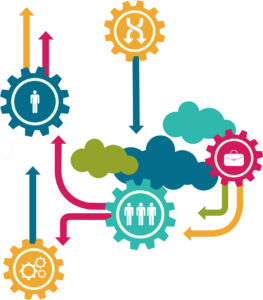
If the buzz from CES 2026 made one thing clear, it’s that the age of the solitary AI chatbot is over. This year’s defining trend wasn’t a new device, but a new paradigm: intelligent agents moving from tech demos to tangible products. From next-generation AI chips designed for low-latency agent inference to robotics platforms advertising “agentic brains,” the hardware foundation for autonomous systems is being laid. For forward-thinking enterprises, 2026 is the year to move beyond viewing agents as simple copilots and start architecting them as autonomous workflow orchestrators—systems that don’t just answer questions, but perceive, plan, and execute complex sequences of tasks to achieve business goals.
This evolution marks a fundamental shift in how we deploy intelligence. We are transitioning from tools that assist with individual tasks to creating a strategic orchestration layer that connects data, applications, and business logic. This article explores the technical leap from prototype to production, focusing on the open-source frameworks and architectural principles making this transformation possible.
The 2026 Agent: Evolving Capabilities Beyond the Prototype
The agents showcased just a year ago were often brittle, single-purpose scripts. The 2026 agent, powered by the hardware and model advancements hinted at at CES, is a different beast, defined by three core capabilities:
- Strategic Planning and Decomposition: Modern agents can break down a high-level objective (“Optimize the Q3 marketing campaign”) into a dynamic sequence of actionable steps: research competitors, analyze past performance data, generate creative briefs, and allocate budget across channels. They don’t just follow a preset flowchart; they create and adjust the plan based on real-time feedback.
- Tool Mastery and API Orchestration: An agent’s power is multiplied by its ability to use tools. In 2026, this goes beyond simple web search. Production-grade agents are integrated with your internal ecosystem—they can query the data warehouse via SQL, trigger a model retraining pipeline via an MLOps platform, generate a report in Google Sheets, or create a ticket in Jira. They act as the universal API connector, executing workflows across siloed systems.
- Memory and Continuous Learning: Temporary chat memory is insufficient for orchestration. Robust agents now possess both short-term context (the current multi-step task) and long-term memory (vector databases storing past decisions, outcomes, and user feedback). This allows them to learn from interactions, improve processes over time, and provide consistent, context-aware operations.
Building the Orchestrator: The Open-Source Tech Stack for 2026
The move to production hinges on a stable, transparent, and flexible technology stack. The open-source community is at the forefront of providing the essential building blocks:
- Orchestration Frameworks: Tools like LangGraph and CrewAI have become foundational. They allow developers to define the “brain” of the agentic system—specifying agent roles, structuring their interaction patterns (hierarchical, collaborative, sequential), and managing the flow of state and memory between them. This is the control plane for your autonomous workflows.
- The Agent Core: While closed-source LLMs are powerful, the rise of specialized, fine-tuned open-source models is key for reliable, cost-effective, and private orchestration. Models excelling at tool calling, reasoning, and instruction-following (like advanced versions of Llama or Mistral) are being deployed on-premise to power sensitive business workflows without data ever leaving the environment.
- Execution Environment: Agents need a reliable place to run. Containerized deployments (Docker) managed by Kubernetes are becoming standard, ensuring agents are scalable, resilient, and observable. This ties directly into the new hardware trend: containerized agent clusters can be deployed across hybrid environments, from the cloud to on-premise GPU servers and even to the edge hardware showcased at CES for low-latency decision-making.
From Hype to Implementation: Key Workflow Patterns for 2026
Identifying the right workflow is critical. Effective orchestrators excel in scenarios that are process-heavy, involve multiple systems, and require consistent execution.
- The End-to-End Analyst: An agent that is triggered by a data alert, autonomously investigates by querying databases and logs, generates a root-cause analysis report, and posts it to a Slack channel—all before a human engineer has finished their coffee.
- The Personalized Operations Agent: In customer support, an agent doesn’t just retrieve FAQs. It accesses the user’s purchase history, analyzes recent support tickets, assesses sentiment, and orchestrates a resolution: perhaps generating a personalized troubleshooting guide, processing a return via the ERP system, and scheduling a follow-up—all in a single workflow.
- The Proactive Resource Optimizer: For IT or cloud ops, an agent continuously monitors resource utilization, predicts bottlenecks based on trends, and autonomously executes approved scaling actions or cost-optimization tasks by interfacing directly with infrastructure APIs (AWS, Azure, GCP).
A Blueprint for Production: Your 2026 Implementation Roadmap
- Start with a Contained Process: Choose a single, well-defined workflow with clear inputs, decision points, and a finite set of tools/APIs. Avoid mission-critical processes for your first major orchestrator.
- Architect for Observability from Day One: Log every agent decision, tool call, and outcome. Implement tracing (e.g., using OpenTelemetry) to visualize the agent’s “chain of thought” for debugging and audit purposes. You cannot manage what you cannot see.
- Design a Robust Human-in-the-Loop (HITL) Protocol: Define clear escalation gates. The orchestrator should autonomously handle 90% of cases, but for specific high-stakes decisions, low-confidence scenarios, or exceptions, it must seamlessly pause and request human input.
- Iterate on a Hybrid Model Strategy: Use powerful, generalist models for planning and reasoning, but delegate specific tasks (like code generation or data analysis) to smaller, specialized, fine-tuned models. This “mixture-of-agents” approach improves speed, cost, and accuracy.
Conclusion: Orchestration as a Competitive Core
CES 2026 showcased the hardware that will run the agents; the real business advantage lies in the software that defines their intelligence. By moving AI agents from prototypes to autonomous workflow orchestrators, companies stop automating tasks and start automating operations. This creates a resilient, self-optimizing layer atop your digital infrastructure.
In 2026, the question is no longer “Can we build an agent?” but “How do we architect an organization where intelligent agents reliably orchestrate our most valuable workflows?” The companies that answer this question will unlock a new tier of efficiency, innovation, and strategic agility.
Ready to architect your autonomous workflow orchestrators? Clear Data Science specializes in building sophisticated, open-source-based AI agent systems that transition from prototype to production, turning strategic hype into operational reality. Contact our team of innovators to design your agentic future.
Keywords: AI Agents, Autonomous Workflows, Workflow Orchestration, LangGraph, CrewAI, Open Source AI, Agentic AI, AI Automation, AI in Production, CES 2026, Clear Data Science.